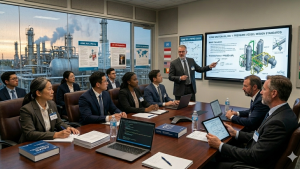



Join PetroSync API Training to improve team productivity, boost operational efficiency, and reduce costs while staying ahead of competitors.
In today’s engineering-driven industries, standing still is often more dangerous than making the wrong move. While you focus on keeping operations stable, your competitors may already be upgrading their teams, aligning with global API standards, and quietly winning projects you once dominated. This is the uncomfortable reality many business leaders face—but it is also where smart decisions begin.
Below is a story that may feel familiar to you.
When Your Competitors Move Faster Than Your Engineering Team
You may have a capable engineering team—experienced, loyal, and technically sound. Yet suddenly, competitors are delivering projects faster, passing audits more smoothly, and responding to client demands with confidence.
What changed?
In many cases, it is not manpower. It is standards mastery. Companies that invest early in globally recognized API training empower their teams to work with clarity and speed. Engineers who understand API codes do not hesitate; they make decisions backed by standards, not assumptions.
This is where structured programs like API 579 training become critical. Fitness-for-Service knowledge allows engineers to evaluate equipment integrity quickly—reducing unnecessary shutdowns while maintaining safety. Faster decisions mean higher team productivity and fewer operational bottlenecks.
The Hidden Cost of Ignoring Global API Standards
Many organizations underestimate the cost of not upgrading competencies. Delayed inspections, conservative over-repairs, and repeated rework quietly drain budgets.
Operational efficiency suffers when teams lack standard-based judgment. According to industry benchmarks, standardized inspection and assessment frameworks can improve operational efficiency by up to 20–30%, primarily by reducing rework and unplanned downtime.
Training such as API 570 training and API 510 training equips inspectors and engineers with a shared technical language. This alignment shortens approval cycles, minimizes miscommunication, and prevents costly over-engineering.
The result? Measurable cost savings—both in maintenance budgets and lost production hours.
How Leading Companies Future-Proof Their Teams Before It’s Too Late
Forward-thinking companies do not wait for failure to trigger improvement. They prepare their teams for complexity—whether it comes from stricter audits, aging assets, or digital transformation.
Many of these organizations now combine API-based engineering excellence with AI-powered tools such as internal chatbot systems. These AI chatbots help engineers retrieve standards, procedures, and historical data instantly. Studies across industrial sectors show that AI chatbots can:
Increase team productivity by up to 25% through faster information access
Improve operational efficiency by reducing repetitive administrative tasks
Lower operational costs by minimizing dependency on manual coordination
However, AI is only effective when teams understand the standards behind the answers. Specialized programs like API 936 training ensure that even advanced materials and refractory systems are managed with confidence and compliance.
Technology accelerates performance—but training defines its accuracy.
Choosing Training Today—or Explaining Failure Tomorrow
As a business leader, the question is no longer whether your team needs global-standard competence. The real question is whether you prefer to invest proactively—or explain later why your company fell behind.
PetroSync API Training programs are designed not just to educate engineers, but to protect your business decisions. They help your teams work faster, reduce operational risk, and optimize costs—while positioning your company as a credible, audit-ready, globally competitive organization.
In a market where competitors are moving quickly, choosing not to act is still a choice. And it is often the most expensive one.
If you want your team to speak the same global engineering language as industry leaders, now is the moment to move.
This press release has also been published on VRITIMES