

AI agents aren’t just for tech companies.
From answering customer questions to helping teams find information buried in company documents, AI agents are opening up new ways for businesses to work.
But here’s the challenge: knowing what an AI agent could do is one thing. Actually building and deploying one is another.
For many businesses, the biggest obstacle isn’t the idea. It’s the engineering work required to turn that idea into something useful.
That’s where an AI agent platform comes in.
With Kravos AI, businesses can build custom AI agents around their own needs, knowledge, and workflows—without having to build the entire supporting infrastructure from scratch.
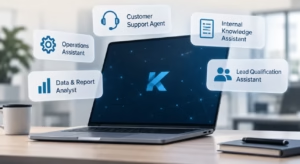
Here are five practical AI agents businesses can explore.
1. The Customer Support Agent
What if your customers could get answers without waiting for someone to respond?
Customer support teams spend a significant amount of time answering recurring questions:
What are your business hours?
How do I track my order?
What is your refund policy?
How do I get started?
A customer support agent can be configured to answer questions using your business’s own information, such as FAQs, product documentation, and support policies.
Instead of manually responding to every routine inquiry, your team can focus on more complex customer concerns.
What you could build:
An FAQ agent for your website.
A product information assistant.
A support assistant that helps customers navigate common issues.
The goal isn’t to replace your entire support team. It’s to give them a way to handle repetitive inquiries more efficiently.
2. The Internal Knowledge Assistant
Your company’s information is only useful if people can actually find it.
Policies, onboarding documents, project files, and internal processes often end up scattered across different platforms.
Employees may spend more time searching for information than using it.
An internal knowledge assistant can help employees retrieve relevant information by asking questions in natural language.
For example:
“What is our process for approving a new supplier?”
Instead of searching through multiple documents, an employee can ask an agent configured around the company’s knowledge base.
What you could build:
An employee onboarding assistant.
An internal policy assistant.
A company knowledge retrieval agent.
The value is simple: make organizational knowledge easier to access and use.
3. The Operations Assistant
How much of your team’s day is spent answering the same internal questions or following repetitive processes?
Operations teams manage a wide range of recurring tasks, from understanding procedures to coordinating information across departments.
An operations assistant can be configured to help employees navigate established workflows and retrieve the information they need.
For example, an operations agent could help a team member understand the steps required to process a request or locate the correct procedure for handling a recurring issue.
What you could build:
A standard operating procedure (SOP) assistant.
A process documentation assistant.
An operations knowledge agent.
The opportunity is to make your company’s processes easier to understand, access, and follow.
4. The Data and Reporting Assistant
Your business already has data. But can your team turn it into useful answers?
Businesses generate information every day.
Reports, performance metrics, customer feedback, and operational records can provide valuable insights—but only if people can interpret them.
A data and reporting assistant can help users retrieve information, understand documented metrics, and summarize relevant findings from connected knowledge sources.
For example:
“What were the key findings from our latest customer satisfaction report?”
An agent configured with the relevant report could help surface the information needed to answer that question.
What you could build:
A report summarization assistant.
A business documentation assistant.
An information retrieval agent for internal reports.
The potential benefit is making information easier to understand and act on.
Note: More advanced capabilities, such as querying live databases or generating dynamic analytics, depend on the tools and integrations configured for the agent.
5. The Lead Qualification Assistant
Not every inquiry is an opportunity—but every inquiry deserves to be understood.
Sales teams often receive inquiries from people with different needs, budgets, and levels of readiness.
A lead qualification assistant can help gather information, answer initial questions, and guide prospective customers through a preliminary conversation.
For example, an agent could help a potential customer understand a product’s features before directing them to the appropriate sales representative.
What you could build:
A product inquiry assistant.
A preliminary sales information agent.
A lead qualification assistant.
The objective is to help sales teams spend more time on meaningful conversations and less time handling repetitive initial inquiries.
Automated lead scoring, CRM updates, and other sales actions depend on the integrations and tools available to the agent.
The Common Thread: You Don’t Need to Build Everything From Scratch
These five examples may serve different purposes, but they share one important requirement.
They need more than an AI model.
They need relevant knowledge, defined behavior, the right tools, and a way to deploy and manage the agent.
This is where the infrastructure behind an AI agent becomes important.
At Kravos AI, we believe businesses should be able to focus on building the agents they actually need—not spending all their time building the infrastructure that supports them.
Kravos is a platform for building and deploying custom AI agents.
You bring the use case. You define the agent. You build it on Kravos.
We provide the platform and supporting infrastructure.
Start Building What Your Business Needs
The best AI agent isn’t necessarily the most complicated one.
It’s the one that solves a real problem for your team.
Start with a repetitive task. Identify the information your agent needs. Define what it should do. Then build from there.
The opportunity isn’t limited to businesses with large engineering teams.
It’s about making AI agents more accessible to the people who know their business best.
Build what’s next.
Explore Kravos AI at kravos.ai.
This press release has also been published on VRITIMES